In honor of the coronation
of King Charles III, looking back at his mother’s ceremonial gown: “The Story
Behind Queen Elizabeth II's Dazzling—and Highly Symbolic—Coronation Gown”…an
article by Emily Chan for Vogue. [reprinted below]
As preparations were underway for Queen Elizabeth II’s
coronation in 1953, Her Majesty only had one couturier in mind to design her
gown for the historic occasion: Norman Hartnell. The British dressmaker had of
course created her beautifully embroidered wedding dress—made from duchesse
satin that the Queen famously purchased with ration coupons—for her marriage to
Prince Philip in 1947.
“One October afternoon in 1952, Her Majesty the Queen desired
me to make for her the dress to be worn at her Coronation,” Hartnell recalled
in his 1955 autobiography, Silver and Gold. “I can scarcely remember what I
murmured in reply. In simple conversational tones, the Queen went on to express
her wishes. Her Majesty required that the dress should conform in line to that
of her wedding dress and that the material should be white satin.”
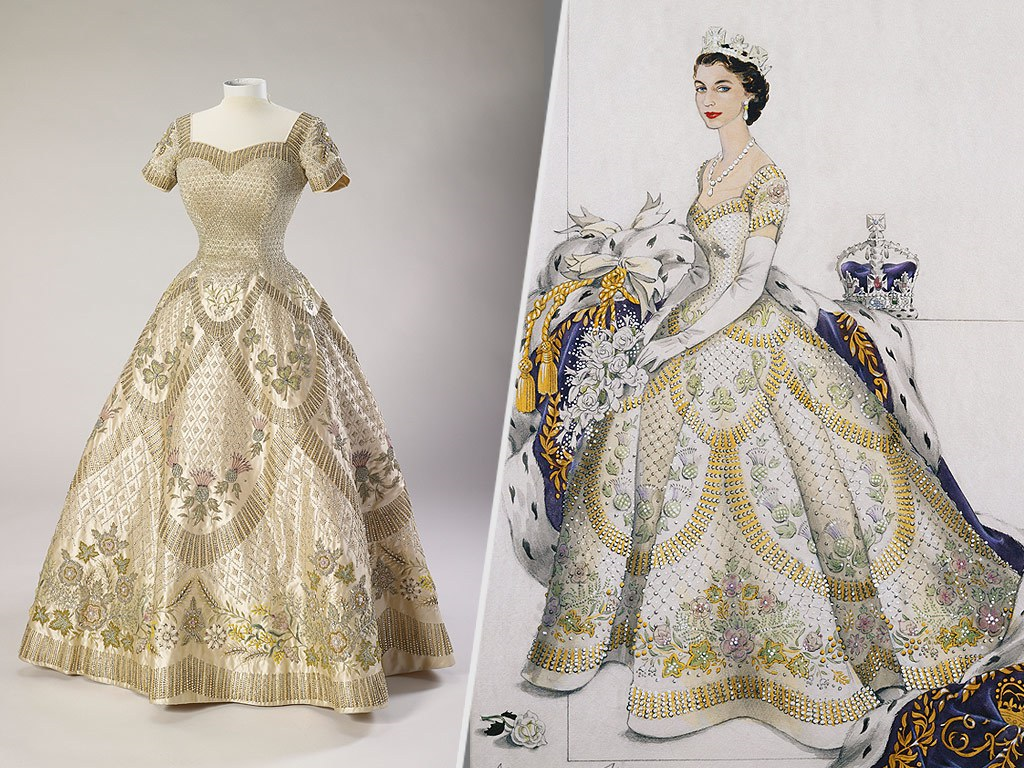
Soon afterwards, Hartnell submitted eight designs to fulfill
the brief, the first of which was based on Queen Victoria’s coronation gown—a
white satin dress with gold embroidery. Other sketches featured the Tudor rose
and oak leaves, alongside one design based around the Madonna. Elizabeth opted
for the eighth design, which incorporated the national emblems of the United
Kingdom: the rose (England), thistle (Scotland), shamrock (Northern Ireland),
and daffodil (Wales)—although the latter was changed to the leek, the official
national emblem of Wales.
The Queen requested several other modifications to the
design, including that the embroidery be done using pastel-colored silks,
rather than just silver. Her Majesty also asked for national symbols of
Commonwealth countries to be added, including the acacia (Australia), fern (New
Zealand), maple leaf (Canada), protea (South Africa), lotus (India), and wheat,
cotton, and jute (Pakistan).
The finished coronation gown featured a sweetheart neckline
and a delicate lattice design, with the emblems—decorated with seed pearls,
sequins, and crystals—separated by heavily embellished scalloped borders
comprising gold bugle beads, diamantés, and pearls. Hartnell also included a
surprise for Her Majesty: a four-leafed shamrock on the left side of the skirt
as a symbol of good luck.
.jpg)
A long-time repeat wearer, the Queen actually went on to
wear the Coronation gown a further six times, including at the opening of
parliament in New Zealand and Australia in 1954. It’s an attitude towards
fashion that the late monarch has certainly passed down to her son, King
Charles III, as he is crowned at Westminster Abbey on Saturday.




.jpg)




 Posts
Posts


