Showing posts with label Vogue. Show all posts

May 6, 2023

A Gown of History

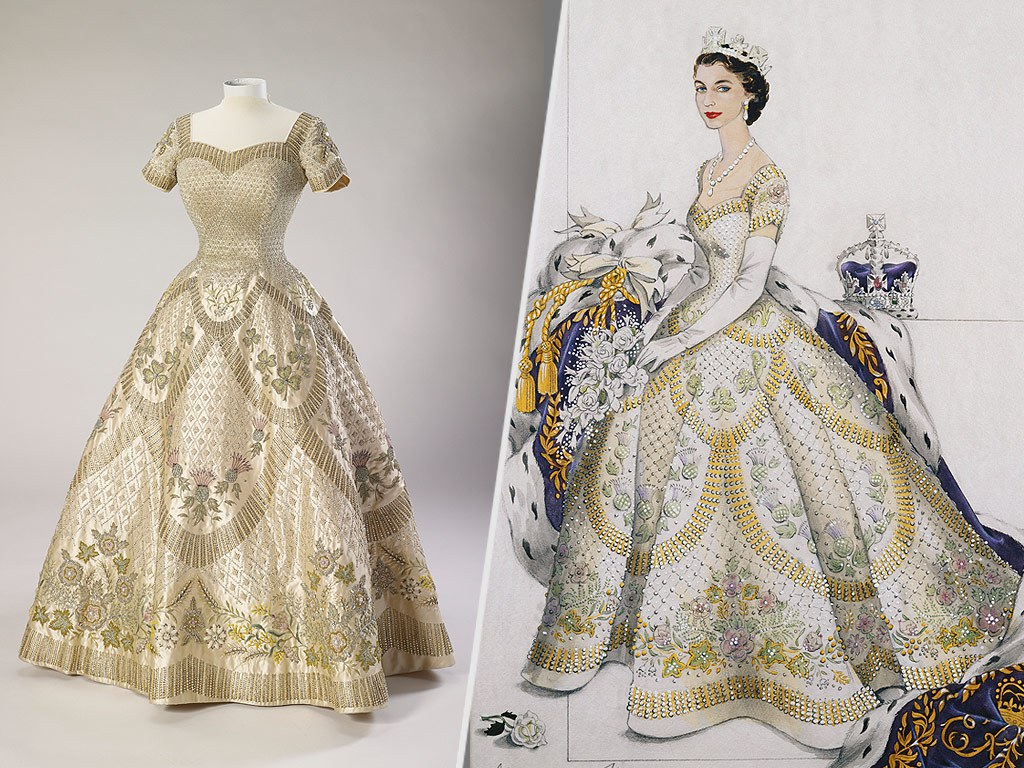
In honor of the coronation of King Charles III, looking back at his mother’s ceremonial gown: “The Story Behind Queen Elizabeth II's Dazzling—and Highly Symbolic—Coronation Gown”…an article by Emily Chan for Vogue. [reprinted below]

As preparations were underway for Queen Elizabeth II’s coronation in 1953, Her Majesty only had one couturier in mind to design her gown for the historic occasion: Norman Hartnell. The British dressmaker had of course created her beautifully embroidered wedding dress—made from duchesse satin that the Queen famously purchased with ration coupons—for her marriage to Prince Philip in 1947.

“One October afternoon in 1952, Her Majesty the Queen desired me to make for her the dress to be worn at her Coronation,” Hartnell recalled in his 1955 autobiography, Silver and Gold. “I can scarcely remember what I murmured in reply. In simple conversational tones, the Queen went on to express her wishes. Her Majesty required that the dress should conform in line to that of her wedding dress and that the material should be white satin.”

Soon afterwards, Hartnell submitted eight designs to fulfill the brief, the first of which was based on Queen Victoria’s coronation gown—a white satin dress with gold embroidery. Other sketches featured the Tudor rose and oak leaves, alongside one design based around the Madonna. Elizabeth opted for the eighth design, which incorporated the national emblems of the United Kingdom: the rose (England), thistle (Scotland), shamrock (Northern Ireland), and daffodil (Wales)—although the latter was changed to the leek, the official national emblem of Wales.

The Queen requested several other modifications to the design, including that the embroidery be done using pastel-colored silks, rather than just silver. Her Majesty also asked for national symbols of Commonwealth countries to be added, including the acacia (Australia), fern (New Zealand), maple leaf (Canada), protea (South Africa), lotus (India), and wheat, cotton, and jute (Pakistan).

The finished coronation gown featured a sweetheart neckline and a delicate lattice design, with the emblems—decorated with seed pearls, sequins, and crystals—separated by heavily embellished scalloped borders comprising gold bugle beads, diamantés, and pearls. Hartnell also included a surprise for Her Majesty: a four-leafed shamrock on the left side of the skirt as a symbol of good luck.

All in all, the coronation dress weighed a hefty 30 pounds, or 13 kilograms, which combined with the Robe of Estate—which was made of deep purple velvet and an ermine trim, and took 3,500 hours to make—and St Edward’s Crown, was quite the weight for Her Majesty to bear. To finish off her historic outfit, the Queen asked French shoemaker Roger Vivier to create a pair of gold pumps featuring a jewel-encrusted heel and fleurs-de-lis pattern on the upper that matched the motif on both St Edward’s Crown and the Imperial State Crown (worn at the end of the ceremony). When it came to her jewelry, Elizabeth wore a dazzling diamond necklace and earrings that were originally made for Queen Victoria.

A long-time repeat wearer, the Queen actually went on to wear the Coronation gown a further six times, including at the opening of parliament in New Zealand and Australia in 1954. It’s an attitude towards fashion that the late monarch has certainly passed down to her son, King Charles III, as he is crowned at Westminster Abbey on Saturday.


November 29, 2020

{The Crown and "That" Dress}

Diana on the left; Emma Corrin in "The Crown" on the right
For me, the brightest star of The Crown television series on Netflix is its head costume designer, Amy Roberts. I've written for years, including in The End of the Fairy-Tale Bride: For Better or Worse, How Princess Diana Rescued the Great White Wedding, about the design of Diana Spencer's wedding gown, so I appreciate Amy's story of re-creating the legendary gown that appeared "on screen" for only a few poignant moments.

Emma Corrin in "The Crown," left; Princess Diana, right
When The Crown first announced "that gown" would be part of its Season Four storyline, their Twitter account posted: "Emmy award-winning costume designer Amy Roberts wanted to capture the same spirit and style of David & Elizabeth Emanuel’s original design, without creating a replica for Emma Corrin."

Emma Corrin on "The Crown"

Here is what journalist Lela London wrote in Forbes:

The second Diana took her vows in a gown with a 25-foot train, it became one of the most iconic wedding dresses in history.

The silk taffeta gown was hand-crafted by David and Elizabeth Emanuel at the time, and The Crown’s costume department consulted with the Emanuels to ensure the replica dress—worn for just a few seconds in the series—was as similar as possible. The original designers even gave them its patterns.

"We were filming the scene when you first see her in the wedding dress—I think it was Lancaster House in London—and I had a team of about ten people helping me put it on, because it's massive," Corrin told British Vogue.

"I walked out and everyone went completely silent. More than anything else I wear in the series, it’s so…it’s her."

Emma Corrin on "The Crown"
Vogue shared a background story of creating the real gown by David and Elizabeth Emanuel. And read more details and entertaining anecdotes in my book The End of the Fairy-Tale Bride: For Better or Worse, How Princess Diana Rescued the Great White Wedding.
 

December 22, 2019

{Something Blue and New}

...and something from Vogue: 
The English custom of brides wearing “something blue” on their wedding day dates back to the 1890s and a little old rhyme you may have heard of: “something old, something new, something borrowed, something blue, a sixpence in your shoe.” The blue bridal token was said to symbolize purity, love, and fidelity.

More than 100 years later, there’s no denying that incorporating a pop of blue is a custom with both meaning and wherewithal, but with 2019’s biggest wedding trend showing a shift toward fresh, fun, laid-back celebrations, it’s only fitting that this time-honored custom would follow suit.


November 23, 2019

{Eco-Friendly Weddings More Important Than Ever}


Attention on planning a “green wedding”—an eco-friendly wedding where the couple tries to decrease the impact of their event on the planet—has been part of wedding planning consciousness for years now. But the stakes have never higher to raise our awareness even more, putting this concern at the front of wedding planning! 

The Knot, the popular wedding magazine and website, has had many articles through the years encouraging brides and grooms to tread lightly; like Tia Albright’s “Your Eco-Friendly Wedding Guide.” And there was a run of guide books a decade or so ago that are still informative: Emily Elizabeth Anderson’s Eco-Chic Weddings from 2007; Wenona Napolitano‘s The Everything Green Wedding Book and Kate Harrison’s The Green Bride Guide, both from 2008; and Mireya Navarro’s Green Wedding: Planning Your Eco-Friendly Celebration from 2009.

Current articles to read: Kenzie Bryant wrote for Vanity Fair, “Are Carbon Offsets the Wedding Registry Gift of the Future?”; from Green Wedding Shoes, a “Sustainable Gift Guide” looking to the holidays; and another way to be more “sustainable” is to wear a dress that is truly re-wearable like a “cool, nonchalant and real” one from designer Karen Walker, as shown in Vogue; and “The Ultimate Guide to Ethical Wedding Dresses” is full of creative ideas!

However, with the current climate crisis, it becomes the responsibility of all of us—whether it’s everyday life or special occasions—to raise our consciousness, educate ourselves, and be aware of what we can do to do no damage!

July 20, 2018

{Why Royal Weddings Matter} No. 11: The Honey Month


Enjoy the last of the 11-part series of WHY ROYAL WEDDINGS MATTER celebrating the marriage of Prince Harry and Meghan Markle. "The Honey Month"....posted on Confluence Daily and reprinted below! (Most articles in the series are excerpts from my book, The End of the Fairy-Tale Bride.)

...............................
The Honey Month

In our world of extreme media scrutiny, I love that the most famous newlywed couple on the planet took what appears to be a private honeymoon! “With the world watching,” wrote Elise Taylor of Vogue, “Prince Harry and Meghan, Duchess of Sussex, seemingly did the impossible: They snuck away on a two-week honeymoon.” (And, as of this writing, the media can only speculate on the location!)

The word “honeymoon,” in use since the sixteenth century as British historian Ann Monsarrat explains, is a derivation of a much older term, “honey-month,” describing the first weeks of the newlyweds’ life together at home, or at the home of friends or family, with the not so subtle intent of ensuring offspring. But these were considered rather “low-class words.” So, beginning in the eighteenth century, when it became fashionable for well-to-do couples to take some sort of trip following their wedding festivities, the occasion was called “going away,” thought a more genteel expression.

“Going away” became “the bridal tour” for the wealthy in the nineteenth century. For the British upper-crust, the fashionable thing was to do a tour of the Continent; for affluent Americans of the gilded age, it was to go abroad on a luxury ocean liner then visit the most exotic sites of the day recommended by Baedeker.

There’s a bit of intrigue associating the honey in “honeymoon” and the ancient legend of the honeybee’s luscious nectar with love and sex. In her book, The Hive: The Story of the Honeybee and Us, Bee Wilson muses how human civilization would have barely survived without the honeybee: its wax was used to create light in a dark world and its honey gave nourishment and medicine. But the honeybee also provided poetic mystery and “food for love”—from the devilish to the divine:

It is “sweet, like true love, and delicious, like carnal love, honey can be treacherous and sticky, like false love,” the author asserts. And there’s more. Its thick, syrupy-ness brings up a “dark side of human desire”—like this from Proverbs in the Bible: ‘the lips of an adulteress drip honey and her tongue is smoother than oil’. Yet “pure honey is precious and good, like married love”—as this line from the Highlander poem, Rob Roy, by Andrew Lang suggests: ‘Or will ye be my honey? / Or will ye be my wedded wife?’

Some believe the term “honeymoon” relates to the ancient Viking ritual when, for their aphrodisiac effects, “the bride and groom would eat honeyed cakes and drink mead for the first month of their betrothal”—quite the honey-month! However, the connection to honey and the name honeymoon or its true meaning “cannot be agreed upon,” Wilson continued. Like most early wedding rituals there are hazy origin myths, but what we know for sure is that “the use of honey in marriage rites has been a constant throughout the Indo-European world, and beyond.” For instance, in an age-old Egyptian marriage contract, the husband promised his wife a yearly gift of twelve jars of honey; in archaic Hindu wedding ceremonies, the author added, “the bride’s forehead, mouth, eyelids, ears and genitals were anointed with honey.”

Do we really ‘fall in love’ or do we just ‘fall into a honeypot’? Do we meet our beloved by chance or are we stung by Cupid’s honey-soaked arrow? In stories of mythology, honey plays its delicious part in romance. Becoming known as the young god of love, Cupid—the son of Venus, the Roman goddess of love, and Mars, the god of war—is not only famous for stealing honeycombs, but he also “fires arrows at his victims, sometimes dipped in honey” and they instantly fall in love with the next person they meet. Honeypot, indeed!

Here’s wishing Harry and Meghan many “honeyed” years of marriage! ~


[Excerpts from The End of the Fairy-Tale Bride: For Better or Worse, How Princess Diana Rescued the Great White Wedding. Available on Amazon.]


January 26, 2018

{British Royal Family Engagement Rings}


After the engagement of Prince Harry and Meghan Markle this fall—and the news that Harry designed Meghan's ring—Vogue compiled and shared an anthology, "A Close Look at the British Royal Family's Engagement Rings." Some are heirloom family rings, others were newly designed....

The Vogue article begins with Lady Elizabeth Bowes-Lyon, who became Queen Elizabeth then the Queen Mother, and includes her two daughters, Elizabeth and Margaret, her granddaughter and brides of her grandsons, featuring Princess Diana and her daughter-in-law, Duchess Catherine—who now wears Diana's famous sapphire and diamond engagement ring. 

Prince Harry's mother's ring was originally part of his inheritance; however, he gave it to his big brother when William was planning his engagement to Kate Middleton.

June 30, 2017

{20th Anniversary - Excerpt No. 3}


Continuing our celebration of Princess Diana's contribution to weddings and all the feminine mythology the costumes of that storied ceremony entails! During this memorial summer of the 20th anniversary of her death, I'm sharing excerpts from my book, The End of the Fairy-Tale Bride: For Better or Worse, How Princess Diana Rescued the Great White Wedding.


{excerpt from}
Chapter Three: "A Whiter Shade of Pale"

By the time Diana’s wedding came along, the notion of “virgin white” had not been completely swept away with the sexual revolution. There was still an underpinning of deeply embedded beliefs about the “rules” of wearing subtle shades of white—ivory, cream, beige—inferring one’s virginal status. “Symbolism of color in the bride’s wedding dress seems almost universal,” wrote historian Donald Clay Johnson in 2003. “In Europe and North America, white, symbolizing ‘purity,’ remains the preferred color, a reflection of the pervasive power of English Victorian society to impose its value system throughout many parts of the world.”

Women’s studies scholar Colleen Denney pointed out the sexual ambiguity of Diana’s gown, following in the “fairy-princess ideal” of nineteenth-century royal brides. Denney considered the über-feminine, fluffy, virginal-like gowns of both Princess Alexandra and Princess Diana—two Princesses of Wales marrying almost 120 years apart—representative of “their newly confined circumstances.” The crinoline-style gowns portrayed the “insistence on the continuity of history and tradition, an ever-present cultural memory, and the demands of royal protocol.”

Nonetheless, ruffley-romance was the new again, Vogue-approved fashion of the early 1980s—whether a “throwback” or not. And for these times, the look was fresh, light and feminine—and what Diana Spencer truly wanted to wear. It seems her lack of worldliness and attraction to fairy-tale romance actually worked for her when selecting the designers and her gown. Diana made her choices before she was so wrapped up in an emotional struggle to please everyone—the palace, the public, the media. She was guided by her own intuition as well as the two designers’ vision where silhouette, color, accessories, length of train, and veil style were created to compliment the woman, the setting, perhaps its symbolic place in history, but, definitely, the heart’s desire of the bride.

Since we know now that Diana’s life had a broader arc, was her queenly, Victoria-inspired, femme-femme bridal silhouette a key ingredient in a powerful “modern mythology” being created? Was it all part of some Divine Feminine plan to help usher in a new spirit stirring the cosmos as we approached the end of an old, tired patriarchal millennium?

It may always remain a heavenly secret, but this query beckons. What, indeed, becomes a bridal legend most? An iconic white gown that truly captures her essential self, yet stands out in some fashionably-designed, breathtaking way; where the woman is the star, the gown only her complement, and we are left with a feeling that a goddess just entered the room. ~

September 22, 2015

{A Meandering Path}


Dear Bride-to-Be: 
I always find my customers and audiences curious about the origin of wedding rituals: tossing the garter; exchanging rings; the “something old, something new” rhyme; the bride’s bouquet. These are rituals and traditions so familiar, even comforting, that we’ve accepted them into our modern celebrations—yet a mystery remains.

Their origins are hazy; different societies added different meanings and their practice usually took a meandering path through the centuries, making some hard to trace. Wedding traditions, as author Carol McD. Wallace shares, have “complicated roots.” That’s why I consider wedding rituals come from sacred legends or a kind of fairy tale: folklore from our heritage revealing itself a bit mysteriously.

Whatever rituals and traditions you use in your wedding ceremony—whether in a gilded cathedral or grand synagogue, on some lofty mountaintop or in a serene garden—choose ones that touch your heart, light up your relationship, and move you to deeper expressions of love.

Love. Listen. Let go.
….with love from Cornelia


[Photograph courtesy of Vogue.]


May 29, 2015

{The Princess Myth}


Dear Bride-to-Be: 
In my new book, The End of the Fairy-Tale Bride, I write about the origin and mysteries of the “princess myth”—the underlying desire of women to feel and look like a princess. From my experiences working with thousands of brides through the years, I share how this desire influences many women when planning their wedding and, in some cases, it’s the core reason some want to be a bride! This “princess” desire—stirred by royal brides to Disney princesses—can work to deepen your feminine strength...your goddess nature; or it can move you to live in a fractured fairy tale of illusion and disappointment.

So a recent article in Vogue Daily about wedding gowns caught my eye: “The Cool Girl’s Guide to Wedding Shopping.” It shares that “while there’s nothing wrong with wanting to go traditional, not every bride dreams of a dress of Disney-princess proportions.” The article features colorful, floral, unfussy designer dresses—not a crinoline or corset or pouf in sight! (Of course what’s considered “traditional” hasn’t always been, well, “traditional”—you’ll find intriguing stories in my book.)

Yes, we’re all affected by what’s “fashionable”—even if we’re rebels or free-spirits! So keep that in mind when shopping for a wedding dress: Is it the latest fashion that’s tugging at your heart or maybe 'tis some once-upon-a-time “princess” yearning? Or perhaps something deeper happens when you try on the dress? Something more akin to: “I feel like a destiny-shaping goddess…inside and out!”

Love. Listen. Let go.
…with love from Cornelia

ps: I think you’ll enjoy the various stories and examples in my new book about how this “princess myth” lives in our modern culture…and perhaps you’ll see yourself in one of them! The End of the Fairy-Tale Bride {Volume One} For Better or Worse, How Princess Diana Rescued the Great White Wedding is available at Amazon.com.

[Image above from 1970s Gunne Sax, Jessica McClintock Inc.]