Showing posts with label Confluence Daily. Show all posts

March 17, 2019

{Putting Love on the Ballot}


My guest editorial, "Putting Love on the Ballot," published on Confluence Daily...and reprinted below!

PUTTING LOVE ON THE BALLOT

I recently attended a gathering in Greenville, South Carolina, where author, spiritual teacher, and now candidate for president of the United States, Marianne Williamson was speaking. I wanted to thank her in person for doing something extremely radical: Putting love on the ballot—squarely, unapologetically, powerfully, eloquently. “I am running for president,” she declared, “in order to harness the political potential of our love, our decency, and our compassion. That is who we are, and that is what America should be.” Love is a topic in which Marianne is well-versed.

Her first book, A Return to Love published in 1992, and the first of seven New York Times’ bestsellers (all reflections on the principles of A Course in Miracles), proclaimed simply: “Love is what we were born with. Fear is what we have learned here.” Marianne writes almost as much about fear as love—given fear is a result of hate, both opposites of love. “Fear unchecked grows exponentially. Love poured forth has the power to remove it.”

Does the presence of love really have that much life-changing power? Marianne adds: “...where love is absent, fear sets in.” Just in case we need a real-life reminder: Fear is what elected Donald Trump and powered the destructive growth of dog whistle politics, giving a louder voice to hate-filled rhetoric spewed from the Senate floor to church pulpits. (No halls so ‘hallowed’ as to escape the maliciousness of it all.)  “It’s not the first time,” clarified Ken Burns, the creator of those movingly beautiful American history documentaries. “Human beings are susceptible to politicians that play to our baser instincts, our worst fears of ‘the other’ instead of, as Lincoln said, ‘the better angels of our nature’.”

We are living in a world where it appears that fear is winning. “Without love, our actions are hysterical. Without love, we have no wisdom.” (Marianne doesn’t mince her words!) It’s time to get revolutionary about love. It’s time for a miracle.

“We had a miracle in this country in 1776,” Marianne announced when exploring a run for the presidency last fall, “and we need another one!” (Keep in mind she holds a ‘miracle’ as ultimately a “shift in perception.”) She then gave a little history lesson, since some may have forgotten what that miracle was nearly 250 years ago. Before this county was founded, all of Europe, under “the divine right of kings,” was “run according to a manorial and aristocratic system.” In other words, a king and/or queen and their pals (the aristocracy) were entitled to the land, the wealth, the education—everything! And the rest of the population, the vast majority, “was little more than serfs to that small group.” However, Marianne continued, with the founding of this country, “we turned that entire mindset on its ear.” And when declaring our independence, we declared that “all men are created equal, and that god gave all men the inalienable rights to life and to liberty and to the pursuit of happiness—and governments were instituted to secure those rights.” Consequently, our new nation stumbled right out of the gate, and then stumbled often, not always living up to those principles. And now we’re stumbling again with a government, paraphrasing Abraham Lincoln, functioning only “of a few of the people, by a few of the people, and for a few of the people”—which means, as Marianne explains, “we have subconsciously reverted to an aristocratic paradigm.”

But we are a nation of courageous “problem solvers who have risen up in their time. So yes, we had slavery, but we also had abolition. We had the oppression of women, and we also had two major waves of feminism and the women’s suffragette movement. We had institutionalized white supremacy and segregation, and we also had the Civil Rights Movement.” With that reminder, Marianne is delivering a call to action for this country’s spiritual awakening, “Join the Evolution!”—it is now our turn to be the problem solvers! And that’s where love comes back into it.

Neuroscientist Richard J. Davidson—professor of psychology and psychiatry at the University of Wisconsin-Madison and founder of the Center for Healthy Minds—considers the next frontier for his field is the study of how the practice of love affects the brain and body, believing there is a quality of love that breaks apart boundaries. Can we take this as an affirmation that, in Marianne’s words, “love is a potent force”? Film director Spike Lee, during his passionate Oscar acceptance speech at the recent Academy Awards ceremony, urging us to vote, urging us to “do the right thing,” put it frankly: “Make the moral choice between love versus hate.”

In calling for a course-correction in this country and putting our democracy back on track; for a resetting of our moral compass and putting the lives and well-being of our children first, Marianne Williamson calls for a return to what made the founding of this country so unique; she calls for nothing less than a return to “an ethical center that is the true exceptionalism of the American ideal.” She encourages us to be on the side of “our better angels” and to “stick with love,” as another peacemaker shared. “We have before us,” Martin Luther King, Jr. remarked—with hate staring him in the face—“the glorious opportunity to inject a new dimension of love into the veins of our civilization.”

It’s time for, like in Lincoln’s day, “a new birth of freedom.” It’s time for some old-fashioned love one another like a day-in, day-out practice. Remembering that love is a show of strength, not weakness, it’s time for a love revolution! “Love taken seriously is a radical outlook, a major departure from the psychological orientation that rules the world,” Marianne wrote in A Return to Love over two decades ago. “It is threatening not because it is a small idea, but because it is so huge.”

When I shook Marianne’s hand that afternoon in Greenville—a packed room of mostly women, women of all stripes—thanking her for putting love on the ballot, she replied, “Yes! It’s time to get radical with our love.” Radical, like love as an “essential existential fact.” Radical, like love is “our purpose on earth.” Radical, like your life depended on it! ~

.................................
AUTHOR’S NOTE:
With the success of her books and appearances on Oprah Winfrey’s shows through the years, Marianne Williamson has been a sought-after speaker on the personal transformation circuit. I’ve followed her work, listened to her various recordings, quoted her in my articles and books, and admired her beautiful and effectively intimate way with words. With Marianne, you re-remember that words have power, that love powers all. “Love requires a different kind of ‘seeing’ than we’re used to—a different kind of knowing or thinking. Love is the intuitive knowledge of our hearts. It’s a ‘world beyond’ that we all secretly long for....”


November 9, 2018

{On Display}

Now on exhibition until 6 January 2019
Windsor Castle


Enjoy my series "Why Royal Weddings Matter" 
on Confluence Daily

October 1, 2018

{Amazing Women Aboard the Titanic} Take Two!


We are living in momentous times when women are not just making history, but reshaping history’s narrative. I love reading about women of an earlier era who made a difference, whose courage pushed them forward—when you can find yourself in their story. So I was delighted to read about “The Amazing Women on Titanic”—a two-years-in-the-making event highlighting stories of 19 trailblazing women on board the legendary ship (currently at the Titanic Museums in both Branson, Missouri, and Pigeon Forge, Tennessee.)

Perhaps our fascination with the luxuriously-appointed yet ill-fated RMS Titanic—with a passenger list of some of the period’s most celebrated names and sinking on its heralded maiden voyage in 1912—is as much to do with its compelling life-and-death saga as it is with how the tragedy dramatically punctuated the ending of a gilded era. Just as a bold new century was breaking open, with an outdated culture crumbling, women were to play their part in reshaping a disordered world.

“The Amazing Women on Titanic” features women whose lives echo today’s headlines, as well as our own everyday dreams. There was Edith Chibnall, first-class passenger from England, who had marched with suffragette leader Emmeline Pankhurst in the famous “Black Friday” protest on Parliament in 1910; crew member Violet Jessup who survived this and another ship disaster to write a no-holds-barred book about a working woman’s life at sea; ground-breaking Mennonite missionary Annie Funk, second-class passenger from Pennsylvania who didn’t survive, had founded the first school for girls in Janjgir, India—later named in her memory; and Dorothy Gibson, famous model and pioneering American silent-film actress, the highest paid of her time.

Let’s meet other “amazing” Titanic women:

Best-selling author, well-known journalist, travel writer, and single mother of two, Helen Churchill Candee, who cut short a European research trip after receiving word her son had been injured, booked first-class passage on the Titanic to come back home to the United States. One of the nation’s first professional female interior decorators, Helen also wrote eight best-selling books, including How Women May Earn a Living.

Helen had to walk with a cane for a year after surviving the Titanic; she severely fractured her ankle when escaping the ship yet helped row her lifeboat to safety through the icy Atlantic waters. A board member of the National Woman Suffrage Association, Helen used her fame and political connections to further the cause, then in 1913 she led a Votes for Women parade—with 10,000 estimated participants—down Pennsylvania Avenue on horseback to the steps of the U.S. Capitol, the day before Woodrow Wilson’s inauguration. (It was seven more years, however, before the 19th Amendment was passed then ratified, giving women the right to vote.)

Elsie Bowerman, 22-year-old first-class passenger, became one of the first women barristers in Britain and first woman to present a case at the Old Bailey courthouse and win. Elsie served as a representative of the United Nations’ Secretary General, serving on the UN’s Commission on the Status of Women. On board the Titanic with her mother, a militant activist in the suffrage movement in England, Elsie went on to lead women’s suffrage groups until all women won the right to vote there in 1928.

American fashion journalist, importer and stylist, Edith Rosenbaum, 32, had just reported on the fashions at the Paris races for Women’s Wear Daily when she boarded the Titanic in Cherbourg. (Reluctantly because a fortune teller warned her of trouble ahead!) On the night of the sinking, Edith carried a music box in the shape of a toy pig, her good-luck token, and used it to calm frightened children in her lifeboat, twisting its tail to play a popular tune.

Edith became one of the first female war correspondents, reporting from the trenches in World War I (many Titanic survivors were involved in this brutal and game-changing war.) She later changed her last name to Russell when people with “German sounding names” were banned from the couture houses in Paris. During her 95 years, as Titanic expert Hugh Brewster noted, Edith traveled extensively, weathering other catastrophes from car accidents to tornadoes: “I’m accident prone,” she once said. “I’ve had every disaster but bubonic plague and a husband.”

For the spirited Irene (René) Harris—on board with her husband Harry, a leading New York theatrical producer—being on the Titanic had been a joyous experience. However, she slipped on the grand staircase before the formal dinner on Sunday evening, fell and broke her arm (her heel may have gotten caught in her fashionably narrow hemline.) Hours later René had to be lifted and carefully placed in a lifeboat—she made it, husband Harry did not. René took over the family theater business back in New York, becoming the first woman producer of Broadway plays and musicals, backing or managing more than 200 during her two-decade career.

American Margaret Brown—wife of a Colorado millionaire, a miner who struck it very rich—had been in Paris when she received a wire that her grandson was seriously ill and was heading home to be with her family. Margaret was a powerful advocate for human and women’s rights, worked tirelessly for suffrage and literacy for children, historic preservation and, after the accident, the Titanic Survivors’ Committee.

Margaret, at age 44, was called the great heroine of the disaster, taking charge of her lifeboat, organizing the other women to row to keep warm during the frigid night, and guiding them to the rescue ship the next morning. She would become even more famous after her death when Broadway and Hollywood produced musicals based on her life, calling her “unsinkable” and renaming her “Molly.”

But the most famous of the “amazing” women on board Titanic (and the elegant centerpiece of the Titanic Museums’ exhibits in Branson and Pigeon Forge) was Lucy, Lady Duff Gordon. The celebrated British couturiere who, under the name of Lucile, “was known for her innovative and provocative designs plus savvy self-promotion, attracting royalty, socialites and entertainment figures to her coveted brand—women whose influence set the fashions of the day,” explains her biographer (and my costume buddy) Randy Bryan Bigham. “She helped usher in sexy lingerie, looser corsets, and the modern runway show,” he shares in Lucile – Her Life by Design.

To get a sense of the unprecedented scope of Lucy Duff Gordon’s achievements, Bigham remarked that “Lucile was one of the first important female haute couture designers, the first major London-based couturiere, and the first leading designer to open full scale branches in America. She also was the first top name in fashion to do lower-priced lines and to launch perfumes and cosmetics.” (Lucile was so famous during this time, she even got a mention on Downton Abbey, the wildly popular period costume drama—its storyline beginning with the news of Titanic’s sinking!)

By the time Lady Duff Gordon boarded the RMS Titanic in April of 1912 with her husband Sir Cosmo Duff Gordon and her secretary, known as “Franks” (they all survived, but there was a whiff of scandal), Lucy was acclaimed and wealthy—“a celebrity in her own right” with Lucile salons in London, Paris, New York and Chicago, explained Bigham. She was traveling to New York incognito, away from the usual media spotlight that followed her, to be able to rest and relax on the grand luxury liner. Fate, however, had other plans.

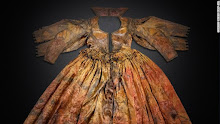
For a rare treat, presented into early 2019 as part of “The Amazing Women on Titanic” exhibits, a collection of original Lucile designs is on display: beautiful evening gowns, wedding dresses (worn by the rich and famous), lingerie, accessories (including two fabulous hats), and charming ephemera—most items from Randy Bryan Bigham’s own collection. (Other garments and accessories from FIDM Museum in Los Angeles; Canada’s Fashion History Museum in Ontario; and private collectors Inger Sheil and Lisa Kominek.) A lovely way to honor all women of the era.

I don’t know about you, but reading about women of history, especially women unknown to me, seems to infuse modern life with a certain quality, like a fresh perspective and vitality. It’s as though bringing their lives into my awareness gives me something of their energy, their vision—like they knew I’d be here to carry on. ~ 

[This is reprinted, with extra images, from Confluence Daily online magazine. For more details about “The Amazing Women on Titanic” and the Lucile design exhibitions: TitanicBranson.com and TitanicPigeonForge.com. And thanks to Titanic author Hugh Brewster and Lucile and Dorothy Gibson biographer Randy Bryan Bigham for informative details.]

July 20, 2018

{Why Royal Weddings Matter} No. 11: The Honey Month


Enjoy the last of the 11-part series of WHY ROYAL WEDDINGS MATTER celebrating the marriage of Prince Harry and Meghan Markle. "The Honey Month"....posted on Confluence Daily and reprinted below! (Most articles in the series are excerpts from my book, The End of the Fairy-Tale Bride.)

...............................
The Honey Month

In our world of extreme media scrutiny, I love that the most famous newlywed couple on the planet took what appears to be a private honeymoon! “With the world watching,” wrote Elise Taylor of Vogue, “Prince Harry and Meghan, Duchess of Sussex, seemingly did the impossible: They snuck away on a two-week honeymoon.” (And, as of this writing, the media can only speculate on the location!)

The word “honeymoon,” in use since the sixteenth century as British historian Ann Monsarrat explains, is a derivation of a much older term, “honey-month,” describing the first weeks of the newlyweds’ life together at home, or at the home of friends or family, with the not so subtle intent of ensuring offspring. But these were considered rather “low-class words.” So, beginning in the eighteenth century, when it became fashionable for well-to-do couples to take some sort of trip following their wedding festivities, the occasion was called “going away,” thought a more genteel expression.

“Going away” became “the bridal tour” for the wealthy in the nineteenth century. For the British upper-crust, the fashionable thing was to do a tour of the Continent; for affluent Americans of the gilded age, it was to go abroad on a luxury ocean liner then visit the most exotic sites of the day recommended by Baedeker.

There’s a bit of intrigue associating the honey in “honeymoon” and the ancient legend of the honeybee’s luscious nectar with love and sex. In her book, The Hive: The Story of the Honeybee and Us, Bee Wilson muses how human civilization would have barely survived without the honeybee: its wax was used to create light in a dark world and its honey gave nourishment and medicine. But the honeybee also provided poetic mystery and “food for love”—from the devilish to the divine:

It is “sweet, like true love, and delicious, like carnal love, honey can be treacherous and sticky, like false love,” the author asserts. And there’s more. Its thick, syrupy-ness brings up a “dark side of human desire”—like this from Proverbs in the Bible: ‘the lips of an adulteress drip honey and her tongue is smoother than oil’. Yet “pure honey is precious and good, like married love”—as this line from the Highlander poem, Rob Roy, by Andrew Lang suggests: ‘Or will ye be my honey? / Or will ye be my wedded wife?’

Some believe the term “honeymoon” relates to the ancient Viking ritual when, for their aphrodisiac effects, “the bride and groom would eat honeyed cakes and drink mead for the first month of their betrothal”—quite the honey-month! However, the connection to honey and the name honeymoon or its true meaning “cannot be agreed upon,” Wilson continued. Like most early wedding rituals there are hazy origin myths, but what we know for sure is that “the use of honey in marriage rites has been a constant throughout the Indo-European world, and beyond.” For instance, in an age-old Egyptian marriage contract, the husband promised his wife a yearly gift of twelve jars of honey; in archaic Hindu wedding ceremonies, the author added, “the bride’s forehead, mouth, eyelids, ears and genitals were anointed with honey.”

Do we really ‘fall in love’ or do we just ‘fall into a honeypot’? Do we meet our beloved by chance or are we stung by Cupid’s honey-soaked arrow? In stories of mythology, honey plays its delicious part in romance. Becoming known as the young god of love, Cupid—the son of Venus, the Roman goddess of love, and Mars, the god of war—is not only famous for stealing honeycombs, but he also “fires arrows at his victims, sometimes dipped in honey” and they instantly fall in love with the next person they meet. Honeypot, indeed!

Here’s wishing Harry and Meghan many “honeyed” years of marriage! ~


[Excerpts from The End of the Fairy-Tale Bride: For Better or Worse, How Princess Diana Rescued the Great White Wedding. Available on Amazon.]


July 2, 2018

{Why Royal Weddings Matter} No. 10: Tokens of Abundance & Love

Here's the latest installment of my "Why Royal Weddings Matter" series for Confluence Daily...excerpts from The End of the Fairy-Tale Bride with updates from the recent wedding of Prince Harry and Meghan, Duchess of Sussex. Enjoy!

............................................................
Tokens of Abundance & Love

Most wedding rituals today are “rooted in the potent mix of tradition and superstition,” wrote Barbara Tober, former editor-in-chief of Bride’s magazine.  

Take the rhyme, something old, something new, something borrowed, something blue, and a sixpence for your shoe—the familiar little verse that became a beloved personal ritual for generations of brides. The rhyme itself may not be that old (first appearing in print in the nineteenth century according to my research), but the customs it describes have been around for centuries. In cultures worldwide and for as long as we know, there was some sort of ritual conjured up out of superstitious notions encouraging brides to tuck “tokens of abundance” (pieces of bread, a lump of sugar, bits of ribbon, a silver charm or coin) into their purse, glove, or shoe; or sew the item into their bodice or dress hem. This was all done in the desire to call forth good luck, great fortune—including the birth of a male heir—or some magical promise of love forever!

Shoe historian Cameron Kippen declares that throughout ancient times “it was widely accounted wearing something borrowed was lucky. The something borrowed varied to something golden or something stolen. A common belief was the bride would enjoy the same luck as the previous owner if the shoes of another happy bride were worn.” (And the good-luck superstitions extended to the groom by wearing old boots loaned to him for his wedding.)

The historian also reminds us that “a long standing bridal superstition stated no harm could befall a bride wearing blue.” Through the ages, wide-ranging references to the color blue surround it with compelling, even divine properties. The color is often associated with Mary, mother of Jesus, and Brigit, the Celtic goddess of healing and the arts; and in Ayurvedic wisdom, the color blue is linked with the throat chakra, or energy center, and inspires balance in our true self-expression. It is cited in Geoffrey Chaucer’s fourteenth-century The Canterbury Tales as a symbol of truth and faithfulness and Shakespeare fondly considered the “blue of heaven’s own tinct....”

With such rich folkloric history, it stands to reason that somewhere along the way a sentimental poet neatly put it all together in a romantic rhyme—some think derived from an old Italian saying, others believe it’s British in origin. Proving, once again, that wedding traditions have “complicated roots”—to borrow a phrase from Carol McD. Wallace’s book, All Dressed in White. Whatever the origin of the rhyming verse, nineteenth-century Victorians popularized it and even royal brides followed its feminine directives for their wedding day.

Princess Diana’s wedding gown designers, Elizabeth and David Emanuel, shared how they custom-fit the rhyme’s legacy for their royal bride:

The old was represented by the piece of Queen Mary lace that we used on the bodice and flounces while the new was obviously the silk dress itself. The tiara that Diana wore was a Spencer family heirloom—so something borrowed—and to complete the tradition, we hand-sewed a little blue bow into the back of the dress.

Following the rhyme continues to be a treasured ritual for many modern brides; not because of any “superstition,” but because it has a way of bringing together generations of women in conversations and remembrances over things we hold dear. A grandmother unpacks a precious family heirloom; a great-aunt shares something from her own trousseau and recalls stories from her mother’s wedding; a sisterly friend offers love, support and deep listening.

Meghan Markle, bride of Prince Harry, extended the rhyme’s sentiment to their post-wedding-ceremony evening party. After changing into a sleek and sexy white halter-neck dress, Meghan wore designer high heels with soles painted pale blue and a fabulous ring with a large aquamarine stone once belonging to her late mother-in-law. (Was the ring a surprise from Prince Harry? Was he in on the “something blue” conversation? Or do you think he simply opened his mother’s jewelry box one day for his beloved to select something of her fancy?)

The “something old, something new” rhyme seems to be infused with a kind of fairy-tale quality and delights of feminine mystique—is the mystery part of its appeal? I call the old-fashioned rhyme the most feminine of all wedding rituals. Whether a bride borrows her grandmother’s handkerchief; wears a gift of birthstone earrings or an antique lace veil; pins a blue silk ribbon to her corset or slips a sixpence coin into her shoe or his pocket, they have put something magically mysterious into motion. And what woman doesn’t become more attractive wearing a bit of mystery? ~

[Excerpts from The End of the Fairy-Tale Bride: For Better or Worse, How Princess Diana Rescued the Great White Wedding, available on Amazon, with updates from Prince Harry and Meghan Markle’s recent “something wonderful” wedding celebration! www.CorneliaPowell.com]


May 9, 2018

{Why Royal Weddings Matter} No. 5: A Whiter Shade of Pale

Enjoy this fifth column in my series "Why Royal Weddings Matter"....reprinted from Confluence Daily.
.................................................................
A Whiter Shade of Pale: 
Meghan Markle and Bridal White

 The centerpiece of the “great white wedding”—a tradition we’ve inherited in all its Victorian glory—is the bride’s gown. Once white became the bridal color in the nineteenth century, the wedding dress became steeped in dreams and emotions and lots of “meaning.”

By the time of Princess Diana’s royal wedding in 1981, bringing weddings back from the brink of nearly two decades of social unrest, the notion of “virgin white” had not been completely swept away with the sexual revolution of the 1960s and ‘70s. There were still underpinnings of deeply entrenched beliefs about the “rules” of wearing different shades of white—ivory, cream, beige—inferring one’s “virginal status.” (“If I wear cream,” a concerned bride-to-be asked me in the early ‘80s, “will people think I’m not a virgin?”) Costume historian Donald Clay Johnson believes the decades’ long “acceptance of white, symbolizing ‘purity,’ is a reflection of the pervasive power of English Victorian society to impose its value system throughout many parts of the world.”

Now, however, in our Internet-equalizer, glam-image crazed world there is a near universal popularity of the gown that turns any bride into a “vision in white” (no matter her age or how many times she’s been married, whether widowed or divorced) and evokes some kind of “princess” tingling down to her toes. Has the color white—once reserved for “maidens” only—finally lost any cultural and emotional symbolism and is now just a “pretty preference” for brides?

Fashion designers think so! The appealingly “unspoiled” nature of white is why many couturiers still have a wedding gown as their theatrical runway finale. When “stripped of religious and outdated cultural meanings, white—pure and dramatic—is the perfect canvas to showcase the intense craftsmanship of couture,” Eleanor Thompson wrote in her book featuring fifty iconic wedding dresses. 

Of course, Meghan Markle is not just any modern, savvy, independent woman getting married again. Her second wedding will be a very publicized, talked about, viewed world-wide royal wedding. So, naturally, there has been much curiosity about Meghan’s choice for her bridal gown: what designer, what style, what silhouette—but very little conversation about what color she will choose. Even though she is marrying into one of the oldest monarchies on earth, in a grand religious ceremony brimming over with ancient tradition, to a man whose grandmother is head of the church—will Meghan make a choice based solely on her good taste and good fashion sense?

Vogue magazine, which thinks Meghan “demonstrates a growing sense of ease and confidence with her fashion choices for royal engagements,” advises the soon-to-be royal bride about her wedding gown choice: “You can’t go wrong with the classics.” (It sounds as if “wearing white” is merely assumed. We, along with the British monarchy, have indeed come a long way!)

In the mid-1980s, on the glittering culture-changing wave following Diana and Charles’ royal wedding, I opened a bridal art-to-wear shop in Atlanta for the emerging modern woman, a “grown-up bride” as I called her. (I closed the store in late 1999; I thought the end of a millennium was a good transition point to complete one life phase and begin another, especially with the coming feminine energy powerhouse of the next thousand years—but that’s another story!) During these shop years, when brides-to-be asked me about the symbolism of white, I suggested that if they had it “mean” anything then why not choose “celebration”—and joy and inclusion and love. I find that wearing white always has a ceremonial and regal quality, for whatever occasion, taking on a kind of radiance. And I think Meghan Markle will choose from this spirit-centered, radiant place where a woman simply knows her true self and her heart’s deepest desire. ~


[Want to know more about the “great white wedding”? The End of the Fairy-Tale Bride: For Better or Worse, How Princess Diana Rescued the Great White Wedding tells all! Available on Amazon.]

April 27, 2018

{Why Royal Weddings Matter} No. 3: Victoria's Choice

The third post in  my "Why Royal Weddings Matter" column for Confluence Daily, "Victoria's Choice," is reprinted below....to get you caught up on royal wedding history!
...................................
Victoria's Choice

If you know one thing about wedding gown history, I would wager that it has something to do with Queen Victoria beginning the bridal fashion of wearing white. (And now, thanks to her, it has been a tradition of sorts for over 175 years.) But I would also wager that most people don’t know the real reason the 20-year-old monarch chose the color white for her wedding gown, breaking the precedent set by earlier princess brides who considered it their right to be “dressed in the usual cloths of silver or gold.” Victoria even chose a crown of fanciful, yet wax orange blossoms instead of one of her dazzling diamond diadems.

Her choices have since been regarded as representing simplicity, modesty and purity—and indeed the young queen was sentimental with an “uncluttered fashion preference,” according to costume historian Kay Staniland. However, Victoria was deeply in love, and this became her guiding inspiration for her wedding attire. Therefore, with much consideration—taking into account her duty, her position and her subjects, carefully discussing her options with her Prime Minister, Lord Melbourne—“the queen decided to make her marriage vows to her ‘precious Angel’ as his future wife rather than as the monarch,” wrote Edwina Ehrman, curator at the Victoria and Albert Museum. So Victoria not only opted against wearing the ornate silver and gold of royalty, but also her regal “crimson velvet robe of state”—first worn at her coronation two years earlier—feeling “it would only emphasize her seniority, and overshadow the role of her future husband,” Staniland added.

Victoria’s all-white bridal costume may have been without the usual opulent royal accoutrements of silver and gold or ermine-trimmed robes, but it “was actually exquisite and of great value,” explained Maria McBride-Mellinger, author of The Wedding Dress. Underscoring “patriotic spending,” the young queen commissioned her country’s renowned textile artisans. The rich silk satin for the gown and its 18-foot court train (Victoria giving a subtle nod to her queenly status) was woven in Spitalfields; and “two hundred women in a Devon village were employed for eight months” making the beautiful, lyrically-patterned bobbin lace for her gown’s embellishments as well as her short veil. The only color Victoria wore was near her heart: a large, brilliant blue sapphire brooch which had been Prince Albert’s wedding gift to her.

On the day of the wedding, Victoria’s adoring subjects happily received their queen’s choices, cheering her carriage on its way to the Chapel Royal at St. James’s Palace. Dressed in these creamy shades of white and tufts of orange blossom, I doubt that Victoria had a sense of the remarkably romantic lineage she was about to inaugurate. (“Queen Victoria’s wedding and her gown inspired an era and an industry,” wrote McBride-Mellinger.) Nor could she ever know that her most queenly exemplar: “Keep your relationship top priority,” would make fine advice for today’s busy wedding-planning brides.

It seems for this young bride (who just happened to be ruler of an empire), that it came down to choosing the feelings of her future husband over her own ego. Victoria’s heart-centered choice changed bridal history and, in turn, illuminated the supreme sovereignty of a woman in love. ~


[Taken from The End of the Fairy-Tale Bride: For Better or Worse, How Princess Diana Rescued the Great White Wedding, available at Amazon.]

April 11, 2018

{Why Royal Weddings Matter} No. 1: The Real Fairy Tale


In celebration of the upcoming royal wedding, I’ve just begun a limited-edition weekly column, “Why Royal Weddings Matter,” on Confluence Daily, an online magazine especially for women. 
The first post, “The Real Fairy Tale,” has excerpted bits from both The End of the Fairy-Tale Bride (available on Amazon) and my book in progress, A Memory of Beauty: The Spiritual Mission of a Princess. 
I've reprinted the article below with some yummy wedding photos. Enjoy!

.................................................................
The Real Fairy Tale

With splendid pageantry and elegant costumes, royal weddings bring up “fairy-tale” dreams of love and romance. “Fairy,” an English word, comes from the French fée, which came from the Latin fatare, “to enchant.” No wonder royal weddings and “enchantment” go hand-in-hand—especially when there is an engaging tug-of-the-heart story with the charms of Prince Harry and Meghan Markle.


Following in his brother Prince William’s footsteps, Harry not only will marry the woman he loves this spring, but his spiritual partner as well. Only a generation before—in the arranged marriage code-of-conduct royal world—such a “love first, duty second, woman with a past” arrangement for any heir to the British throne would have been, if not impossible, certainly one with consequences.

William and Harry’s parents’ wedding in 1981 stirred the hope of “fairy tale” and yet, as Diana and Charles’ marriage played out, any notion of “happily ever after” soon vanished. Theirs was an arranged marriage that pretended it was not. Although times were changing when they married, the social culture had not shifted enough to allow Prince Charles to follow his true feelings. Perhaps even more consequential, the Windsor family was shadowed by kinsman King Edward VIII who in 1936, with some political pressures, gave up the throne “for the woman he loved.” The scandal was a little too close in historical proximity for Charles to make a similar decision about marrying someone for love who didn’t fit the “queenly model.”

Nonetheless, almost seven decades after King Edward’s abdication, cultural changes were on Prince Charles’ side—thanks in great part, ironically, to his late wife insisting on bringing more heart into the royal family. In 2005, 24 years after his marriage of “dynastic duty” to Diana, Charles did not have to give up the throne nor start a palace revolt, yet, with his queen’s blessing, he indeed married the woman who had been his longtime friend and confidante—the woman he had long loved.

In this more modern and egalitarian grand gesture, Charles and Camilla’s marriage put the seal on “love over duty,” supporting Edward’s heartful claim that “he could be a better king with the woman he loved at his side.” With such a legacy, when it was time for Charles’ sons to marry, they fell in love with women who matched their vision and compassion—beautiful “commoners” with “backgrounds” no less!

So call royal weddings “fairy tales” if you must, but the conscious connection that both Princes William and Harry have made in their marriage choices is simply what I call the way life is meant to be when heads are clear and hearts are strong. Whether king or prince or commoner, “what your heart thinks is great, is great,” poet Ralph Waldo Emerson wrote. “The soul’s emphasis is always right.” ~