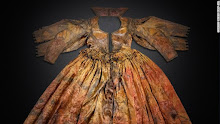
The new Downton Abbey movie is not out until March 2022...and I hear, 'natch, there's going to be a wedding! But the traveling exhibit, Downton Abbey: The Exhibition, is landing in Atlanta this fall! Opening September 25 at Perimeter Pointe for a limited run...and, best of all, displaying over 50 costumes!
Showing posts with label Biltmore Estate. Show all posts
August 31, 2021
February 20, 2020
{That Downton Magic}
I recently
visited Biltmore Estate, the latest host of DOWNTON ABBEY: THE EXHIBITION…called
an “immersive
exhibition that offers a chance to relive the story of the beloved television
series—complete with set recreations, exclusive multimedia elements, and an
up-close look at more than 50 official costumes.”
In the area showcasing the set recreations, in
Biltmore’s new Amherst facility, the
exhibition provides a fascinating look at the post-Edwardian era in which the
popular TV series was set as well as insights into the remarkable events that
shaped the world during this time, such as World War I.
As a social historian, I especially enjoyed this broader look into the era.
Of
course, as a fashion historian, I headed straight to the costume exhibition at a
second location in Biltmore Legacy in Antler Hill Village! A display of more
than 50 costumes from the series’ six-season run, but also for the first time, costumes
from the 2019 Downton Abbey: The Movie were on display—three ensembles worn
by the Royal Family.
It was especially wonderful to see the extraordinary “up
close” details of Princess Mary’s evening gown (on the right in photo below)—perhaps
now my favorite design by costume designer Anna Mary Scott Robbins! (Wish I taken some up close photos!)
However,
it was a bit of a disappointment for me that the labels identifying who wore
each costume and for what occasion did not include more details of its design—or
its designer! (Downton Abbey had four unique costume designers during
the various seasons.) So with that in mind, I’ve shared details below about another favorite
Anna Robbins design from the finale of the series which was featured at the exhibition—Lady
Edith’s wedding gown! (The script is taken from my talk “Vintage Inspiration: The Brides
of Downton Abbey”…enjoy!)
……………………………….
For Lady Edith’s gown for her 1925
New Year’s Eve wedding to Bertie (who went from being his aristocratic cousin’s
land manager to Marquess of Hexham practically overnight), Downton Abbey's season six costume designer, Anna Mary Scott Robbins, created a custom-made gown from lacy
vintage “parts.”
The designer said that Edith's
dress started out as an original Brussels lace dress she found. Then she merged
it with Brussels lace yardage found in vintage fairs with two other pieces that
had a different, more light, gauzier weight to it. These were cleverly used to
create this transparent sheer drop-down to give the dress more length. She created the sleeves and the neck out of another
piece of vintage lace.
Anna wanted the finished dress
to be much more delicate, so they cut away the heavier neckline on the original
dress. And with attention to such detail, she even wanted to create a soft
transition when you see Edith in the dress….“something almost light as
air as it came up on her skin and neck."
……………………………..
Downton
Abbey: The Exhibition
runs through April 7, 2020 at Biltmore Estate…unless 'tis held over like it has been at the other venues during its run!
March 18, 2018
{Titanic Glamour On Board at Biltmore}
By the turn of the 20th century,
when touring the European continent was fashionable for wealthy Americans, transatlantic
travel became luxurious to suit those “gilded age” patrons. Ocean liners like
Cunard’s RMS Aquitania, The French
Line’s S.S. France, and White Star
Line’s RMS Olympic were synonymous with extravagance and glamour.
Now through May 13, 2018, the
exhibition at Biltmore House represents the extensive wardrobes preferred by intercontinental
travelers like George and Edith Vanderbilt in the early 1900s. Visitors will
learn more about the Vanderbilts’ worldwide travels while viewing 45 of the
award-winning “Titanic” costumes, evoking the era’s gilded lifestyle.
Since first-class passengers strolled
the promenade decks, had tea in richly-decorated lounges, and dined at elegant
formal dinners (all dressed-to-the-nines in different outfits for each occasion),
costume designer Deborah Lynn Scott and her team had hundreds of garments to
recreate and authentically accessorize—down to the proper collar studs and cuff
links for the men, and corsets and hatpins for the ladies. (Recreating the hats
alone became a “titanic” task!) Scott’s design team scoured international antique
markets to find as many original period garments as possible; other ensembles
were custom made from original patterns of the era, embellished with vintage
beadwork and appliques.
Entrance to “Glamour on Board: Fashion from Titanic the Movie” at Biltmore is included in the general
admission ticket price. However, a limited number of special-ticket guided
tours are available, taking you behind-the-scenes of the glamorous period! ~
[Reprinted from my article in the Spring issue of SEASON magazine. Images of the costume exhibition inside Biltmore House above courtesy of The Biltmore Company.]
Click here for other Titanic Fashion Happenings!
April 20, 2017
{Social Graces at Biltmore}
Thanks to everyone who attended my special event Social Graces at Biltmore during their "Designed for Drama: Fashion from the Classics" costume exhibition. From enjoying a Jane Austen Social of tea and scones with talks featuring the designers who 'make magic' with period costume dramas to tours of the various costume exhibits around the Estate, a fine time was had by all!
![]() |
| Costumes from "The Golden Bowl" in the Music Room of Biltmore House |
![]() |
| Costumes from "The House of Mirth" in Mrs Vanderbilt's Bedroom in Biltmore House |
![]() |
| Cornelia with 'Social Graces' guests |
March 13, 2017
{A Veil of Distinction} Redux
Continuing our celebration of the ongoing Vanderbilt/Cecil family wedding exhibition at the Biltmore Legacy Museum in Asheville, NC—which opened in February of last year—I'll re-share another article I wrote featuring an antique lace bridal veil on display with celebrity connections. ("A Veil of Distinction" was first published in the 2016 spring issue of Season magazine.) Enjoy!
A Veil of Distinction
Wedding veils hold an especially distinctive yet intimate place in a family’s collective memory. Even more than the wedding gown, the family bridal veil has, historically, been the treasure most often passed down and shared with daughters and granddaughters, nieces and cousins.
That was the case with a certain heirloom veil with a most captivating provenance. First worn by Margaret Merritt as an Edwardian bride when she married James Thomas Lee of New York City in 1903, her cathedral-length, rose point lace veil was also worn by her daughters Marion Lee Ryan, Janet Lee Bouvier and Winifred Lee D’Olier. But this veil developed a particular mystique when her granddaughter Jacqueline Bouvier wore it, along with Margaret’s delicate wreath of wax orange blossoms, for her marriage to Senator John F. Kennedy in 1953.
I became intrigued by this veil’s lineage when I learned it was to go on a first-ever display early this year as part of the wedding costume exhibitions on Biltmore Estate in Asheville, North Carolina. The veil’s connection with the Vanderbilt family is through Jackie Kennedy’s cousin, Mary Lee Ryan—“Mimi” wore it when she married George Vanderbilt’s grandson, William Amherst Cecil, in 1957.
Jackie’s only daughter Caroline Kennedy didn’t wear the Lee family veil, but both Mimi’s daughter and daughter-in-law wore it with their 1980’s Diana-era “princess gowns.” I find this is part of the beauty and pleasure of a bridal veil: as fashions change, it can be adapted to wear in various stylish ways; and even as women and their roles change, because of its strong feminine impulse, the bridal veil always carries a precious tradition.
Later when lace was not as popular and travel to Europe was aboard airplanes instead of ships, bringing home a lace wedding veil stayed dear to the hearts of many American women. Perhaps there is one stored away in your family’s “treasure chest”? ~
February 4, 2017
{Reimagining a Legend - Redux!}
![]() |
| Cornelia Vanderbilt Cecil, at home, Biltmore House 1924 Photo courtesy of The Biltmore Company |
The article offers background on how a design team at Cosprop, Ltd. London recreated Biltmore heiress Cornelia Vanderbilt's 1924 couture wedding gown and accessories—the centerpiece of the museum's exhibit on Biltmore Estate.
![]() |
| Vanderbilt family wedding exhibition at Biltmore Legacy Museum |
July 1, 2016
{A Dress Reimagined}
In celebrating the current Vanderbilt
family wedding exhibition at the Legacy museum on Biltmore Estate in Asheville,
North Carolina, I’ve written several articles about the treasures on display. One is the recreation of Cornelia
Vanderbilt Cecil’s 1924 wedding gown and veiling by Cosprop Ltd. London (of Downton Abbey fame!)
Here’s another version of that fascinating story just published in the summer issue of Season magazine….and I’ve reprinted it here
for you to enjoy. This one gives a bit of background about my former vintage bridal shop, its Downton Abbey connection, and my love of old lace. Would like to hear what you think!
A Dress Reimagined
by Cornelia Powell
by Cornelia Powell
Those of you who visited my former bridal art-to-wear
shop in Atlanta in the 1980s and ‘90s would remember the lovely one-of-a-kind
dresses made from vintage laces. The shop’s designers used found pieces of
original materials: beadwork, laces, embroidery and remnants from beautiful old
gowns that often became the starting point for a new dress, adding richness and
gravitas that only “something old” could do. (“Elegant recycling” is how one of
my designers described the process.)
Downton Abbey’s
designers relied on similar techniques for many of their costumes including 1920s-era
wedding dresses for the Crawley sisters. (Something you already knew if you’ve
attended one of my costume talks!) Designer Caroline McCall combined vintage
lace panels with new silks to make the column-shaped bridal dress for Mary’s
first wedding; then an antique hand-beaded satin train she’d found became the
design inspiration for Edith’s dress for her “almost wedding” in season three.
In the show’s romantic finale, designer Anna Robbins used a collage of vintage
Brussels laces to create Edith’s “happy ending” bridal gown.
What if the lost wedding dress of a famous heiress needed
such superb designer attention? Cornelia Vanderbilt married on her family’s grand
Biltmore estate in 1924, but years later her satin wedding pumps—aged to a
creamy patina and still trimmed with sprigs of fabric orange blossoms—were all
that remained of her costume. So, with an exhibition in mind, Biltmore
commissioned legendary costumier John Bright at Cosprop, Ltd. London—of Downton Abbey fame—to recreate
Cornelia’s lace and silk wedding ensemble.
Once Leslie Klingner, Curator of Interpretation, and her
team at Biltmore gathered archival photographs and newspaper clippings with
descriptions of Cornelia’s dress (details of her wedding had filled society
columns worldwide), the transatlantic “reimagining” project was on! After a
year of planning, conference calls, lace and fabric samples going back and
forth between London and Asheville, NC—plus seven weeks of cutting and sewing
by a team of five—Cornelia’s dress and veil were, indeed, beautifully
reimagined.
Cornelia Vanderbilt Cecil’s original gown was the stylish
“tabard” fashion of the 1920s: a lace tunic over a silk slipper-satin,
long-sleeve sheath (a design that influenced the gown for Downton’s Lady Mary.)
From the photographs, the lace of Cornelia’s gown, with its distinctive floral
pattern, appears to be an exquisite Duchesse; but fine lace yardage from that
era is rare, so Cosprop cleverly repurposed an antique lace shawl and, although
the pattern varied from the original, the proportions were perfect! Cosprop
also recreated Cornelia’s lace headpiece and voluminous veiling—which had included
her maternal grandmother’s rose point heirloom veil—by appliquéing
hand-cut vintage lace motifs onto yards and yards of custom-dyed tulle.
Cornelia’s recreated wedding ensemble is now on display
at Biltmore’s Legacy Museum. To me it’s a lovely reminder how, in the hands of
inspired designers, bits of vintage laces and trims can be “reimagined” to
enchant us still. ~
[Top and bottom three images courtesy of The Biltmore Company]
June 14, 2016
Reimagining A Legend
![]() |
| Cornelia Vanderbilt at home, Biltmore House. April 1924 [Courtesy of The Biltmore Company] |
Enjoy my article “Reimagining A Legend” published in the Huffington Post. It shares a bit of background how Cosprop Ltd. London recreated Biltmore heiress Cornelia Vanderbilt’s circa
1924 wedding ensemble. HuffPost
April 16, 2016
{A Veil of Distinction}
I thought you’d enjoy my article, “A Veil of Distinction,” just published in the spring issue of Season Magazine. Click here to read it online...and I’ve reprinted it below as well.
A Veil of Distinction
Lace was immensely fashionable for Victorian and Edwardian
ladies and, indeed, de rigueur for
brides during these gilded decades. Following the creation of “rose point” lace
in Brussels in the mid-19th century—a type of point de gaze needle lace so named because of its lyrical rose
design, often with raised petals—this romantic pattern became a favorite of
brides. Therefore when well-to-do American women made their grand transatlantic
voyages to Europe on the most majestic luxury liner of the day (it was simply
the thing to do!), high on their must-do list was to bring back a lace veil from
Belgium—all with dreams of a wedding in mind. (Is that how the lovely rose point
veil worn by the Lee family brides—and then the Cecils of North Carolina—began
its notable pedigree?)
A Veil of Distinction
Wedding veils hold an especially distinctive yet intimate
place in a family’s collective memory. Even more than the wedding gown, the
family bridal veil has, historically, been the treasure most often passed down and
shared with daughters and granddaughters, nieces and cousins.
That was the case with a certain heirloom veil with a
most captivating provenance. First worn by Margaret Merritt as an Edwardian
bride when she married James Thomas Lee of New York City in 1903, her cathedral-length,
rose point lace veil was also worn by her daughters Marion Lee Ryan, Janet Lee
Bouvier and Winifred Lee D’Olier. But this veil developed a particular mystique
when her granddaughter Jacqueline Bouvier wore it, along with Margaret’s delicate
wreath of wax orange blossoms, for her
marriage to Senator John F. Kennedy in 1953.
I became intrigued by this veil’s lineage when I learned it
was to go on a first-ever display early this year as part of the wedding
costume exhibitions on Biltmore Estate in Asheville, North Carolina. The veil’s
connection with the Vanderbilt family is through Jackie Kennedy’s cousin, Mary
Lee Ryan—“Mimi” wore it when she married George Vanderbilt’s grandson, William
Amherst Cecil, in 1957.
Jackie’s only daughter Caroline Kennedy didn’t wear the Lee
family veil, but both Mimi’s daughter and daughter-in-law wore it with their
1980’s Diana-era “princess gowns.” I find this is part of the beauty and
pleasure of a bridal veil: as fashions change, it can be adapted to wear in various
stylish ways; and even as women and their roles change, because of its strong
feminine impulse, the bridal veil always carries a precious tradition.
Later when lace was not as popular and travel to Europe
was aboard airplanes instead of ships, bringing home a lace wedding veil stayed
dear to the hearts of many American women. Perhaps there is one stored away in your family’s “treasure chest”? ~
Subscribe to:
Posts (Atom)